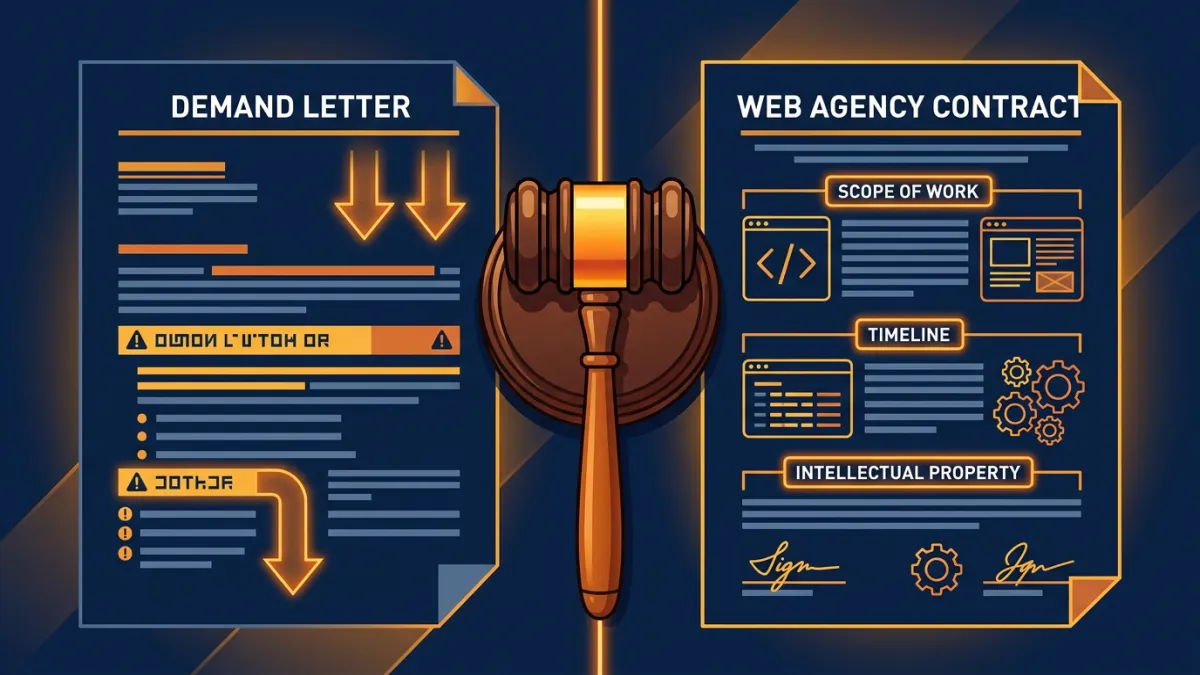
Your agency built a client’s e-commerce site last year. The design looked clean, the checkout flow worked great, and the client was happy. Then a demand letter showed up. An ADA plaintiff alleged the site was inaccessible to screen reader users. Now your client’s lawyer is on the phone asking why the site you delivered violates WCAG 2.1 AA.
Not directly. Under ADA Title III, the legal obligation sits with the business that owns the website, not the agency that built it. But “not directly liable” is not the same as “safe.” Agencies face real financial exposure through client contracts, professional negligence claims, and at least one landmark case where web contractors paid over $2 million. The indirect path to liability is the one that should keep you up at night.
TL;DR: ADA Title III holds website owners liable, not developers. But agencies face indirect exposure through contract indemnification clauses, professional negligence claims, and false claims lawsuits. The 2023 Bashin v. Conduent case resulted in a $2M+ settlement against web contractors. Protect yourself by scoping accessibility explicitly in contracts and documenting compliance efforts continuously.
Who Does ADA Title III Actually Hold Responsible?
ADA Title III applies to “places of public accommodation,” which courts have extended to include websites. The key word is “accommodation.” The business offering goods or services to the public bears the legal obligation. Your agency is not offering goods to the plaintiff, so you have no direct ADA liability to end users. A plaintiff cannot name your agency as a defendant in a standard ADA Title III lawsuit.
That said, the volume of these cases makes it nearly impossible for agencies to ignore. Over 4,000 ADA website lawsuits are filed annually in US courts (EcomBack 2024 Annual Report), and 77% of them target e-commerce sites (EcomBack 2024). If your agency builds e-commerce sites, your clients are in the crosshairs. And when clients get sued, they look for someone to blame.
How Do Agencies Get Dragged Into Client Lawsuits?
There are three paths from “your client got sued” to “you’re writing a check.” None of them involve a plaintiff naming your agency directly. All of them involve your client turning around and pointing at you.
The first is contractual indemnification. If your agency’s contract includes any representation that the delivered website meets accessibility standards, your client can bring a breach-of-contract or indemnification claim against you after being sued. This is the most common exposure path. The second is professional negligence. Clients can argue that a “professional” web developer should have known to build accessible sites. This theory is emerging but not yet widely tested in court. The third is false claims. If your agency explicitly claims WCAG compliance for a government contractor’s site, you may face qui tam whistleblower lawsuits.
What Happened in the Bashin v. Conduent Case?
This is the case every agency owner needs to know. In December 2023, a California court approved a $2M+ settlement against Conduent and US eDirect, the web development contractors who built ReserveCalifornia.com for the California Department of Parks and Recreation (Accessibility.Works). The contractors had explicitly claimed the site was WCAG 2.0 A/AA compliant. It was not. The plaintiff used California’s False Claims Act qui tam provision, which allows private citizens to sue on behalf of the government when contractors misrepresent their work.
Here is the part that makes this portable: 29 other states have similar False Claims Act provisions (Accessible.org). This legal theory is not limited to California. Any agency building sites for government entities and claiming accessibility compliance is exposed to the same risk in the majority of US states. ADA lawsuits surged 37% year-over-year in H1 2025 (EcomBack Mid-Year Report), so the likelihood of this theory being tested again is increasing.
What Does the Contract Risk Actually Look Like?
Not all contract language creates equal exposure. Here is how different clauses affect your agency’s risk:
| Contract Clause | Risk Level | What Happens If the Client Gets Sued |
|---|---|---|
| Agency guarantees WCAG compliance | High | Client sues agency for breach of contract |
| Agency accepts indemnification for accessibility | High | Agency pays client’s legal costs and settlement |
| No accessibility language in contract | Medium | Client may argue professional negligence |
| Agency explicitly excludes compliance from scope | Low | Client bears full liability; agency is insulated |
| Contribution clause (shared liability) | Medium | Courts more likely to honor than full indemnification |
Courts are more likely to throw out full indemnification clauses that shift 100% of liability but will honor contribution clauses that split responsibility (Kris Rivenburgh, Accessible.org). If your contracts currently include blanket indemnification for “all claims arising from the delivered website,” you are accepting risk you probably did not price into the engagement.
Does Agency Insurance Cover ADA Claims?
Probably not, at least not with your current policy. Technology Errors & Omissions (E&O) insurance typically covers coding errors and failures to deliver promised functionality. But ADA violations are civil rights claims, and most E&O policies exclude civil rights liability entirely (Accessibility.Works).
There is a policy type that can cover these claims: Employment Practices Liability Insurance (EPLI) with a third-party coverage rider. This extends coverage to discrimination claims brought by non-employees, including digital accessibility plaintiffs. The problem is that most agencies do not carry EPLI, and even fewer have the third-party rider. Meanwhile, 64% of companies sued for ADA violations in H1 2025 were small-to-mid-size businesses (EcomBack Mid-Year Report), exactly the profile of a typical agency client. If your client does not have coverage either, the finger-pointing lands squarely on whoever built the site.
How Should Agencies Protect Themselves in Client Contracts?
Start with the contract itself. Explicitly scope whether accessibility is included in the engagement or not. Silence is the enemy here. When a contract says nothing about accessibility, both parties assume the other is handling it. Then nobody handles it. Here is a practical approach:
If accessibility IS in scope, define the specific WCAG level (2.1 AA is the current legal benchmark per DOJ guidance), the pages covered, and the testing methodology. Use contribution clauses instead of indemnification. Document everything. If accessibility is NOT in scope, say so explicitly. A single sentence excluding compliance from the deliverables dramatically reduces your exposure.
Beyond contracts, continuous monitoring creates a paper trail. Tools like PageAudit run automated WCAG scans across client sites and flag regressions when a deploy breaks compliance. That documentation becomes evidence of good-faith effort if a dispute ever arises. 94.8% of top websites fail basic WCAG conformance (WebAIM Million 2025), so the baseline is low enough that consistent monitoring puts you ahead of nearly everyone.
What Does an ADA Lawsuit Actually Cost?
A settlement is not just a check to the plaintiff. Here is the full cost structure for a typical mid-size business:
| Component | Typical Cost Range |
|---|---|
| Settlement payment | $5,000 - $75,000 |
| Plaintiff’s attorney fees | Often exceeds settlement amount |
| Mandatory WCAG audit by third party | $5,000 - $15,000 |
| Website remediation | $5,000 - $50,000+ |
| Ongoing monitoring (2-3 years) | Required by settlement |
| Compliance reporting to plaintiff’s counsel | Staff time |
Total cost for a single lawsuit against a mid-size business: $30,000 to $150,000 when all components are included (Accessible.org). Agencies managing 20+ client sites face compounding exposure across their entire portfolio.
For context, automated compliance monitoring at $49/month per site with a tool like PageAudit costs $588 per year. One settlement covers decades of monitoring costs. And 25% of ADA lawsuits in 2024 targeted sites that already had overlay widgets installed (EcomBack 2024), so the “we already have a widget” defense is not a defense at all.
Frequently Asked Questions
Can a Plaintiff Name My Agency Directly in an ADA Lawsuit?
No, not in a standard ADA Title III case. The Americans with Disabilities Act holds “places of public accommodation” liable, which means the business that owns and operates the website. Your agency is a vendor, not a public accommodation. However, this does not mean you are in the clear. The risk comes from the other direction: your client gets sued, and then your client comes after you through breach of contract, indemnification clauses, or professional negligence claims. The Bashin v. Conduent case showed that contractors can face multi-million dollar exposure when they explicitly claim WCAG compliance and the site fails to meet that standard. Over 4,000 ADA lawsuits are filed annually (EcomBack 2024), so the probability of at least one of your clients receiving a demand letter is increasing every year.
Does My E&O Insurance Cover ADA Claims From Client Sites?
In most cases, no. Standard Technology Errors & Omissions insurance covers professional mistakes like delivering buggy code or missing a deadline. ADA violations are classified as civil rights claims, and most E&O policies contain explicit exclusions for civil rights liability (Accessibility.Works). The policy type that can cover these claims is Employment Practices Liability Insurance (EPLI) with a third-party coverage rider. This rider extends coverage to discrimination claims by non-employees, including digital accessibility plaintiffs. But most small and mid-size agencies do not carry EPLI at all, let alone with the third-party extension. If you are concerned about this exposure, talk to your insurance broker specifically about digital accessibility coverage and ask whether your current policy excludes civil rights claims. Given that 64% of companies sued for ADA web violations in H1 2025 were small-to-mid-size businesses (EcomBack Mid-Year Report), this is not a hypothetical risk.
Should My Agency Contracts Mention Accessibility at All?
Yes, always. Silence on accessibility is worse than either including or excluding it. When a contract says nothing, both sides assume the other party is handling compliance. Nobody does. Then when the client gets sued, they argue that you, as the professional web developer, should have known to build accessible sites. Including explicit accessibility language, whether you are scoping it in or out, removes ambiguity. If accessibility is in scope, specify the WCAG level (2.1 AA), the pages covered, and the testing methodology you will use. If it is out of scope, a single sentence excluding compliance from your deliverables dramatically reduces your legal exposure. Use contribution clauses rather than full indemnification when sharing liability. Courts are more likely to honor shared responsibility language than clauses that shift 100% of liability (Kris Rivenburgh, Accessible.org).
What States Have False Claims Laws Similar to California’s?
Twenty-nine US states plus the District of Columbia have False Claims Act provisions with qui tam (whistleblower) provisions similar to the one used in the Bashin v. Conduent case (Accessible.org). Major states on this list include New York, Texas, Florida, Illinois, and Virginia. The qui tam provision allows private citizens to file lawsuits on behalf of the government when contractors misrepresent the quality of their work. For web agencies, this means any government contract where you claim WCAG compliance but fail to deliver it could expose you to a false claims lawsuit, not just in California but in the majority of US states. Given that ADA lawsuits surged 37% in H1 2025 (EcomBack Mid-Year Report), the incentive for plaintiffs to test this legal theory in additional states is growing.
How Much Does an ADA Website Lawsuit Typically Cost to Settle?
Total costs for a mid-size business typically range from $30,000 to $150,000 when you include every component (Accessible.org). That number is not just the settlement payment to the plaintiff, which often runs $5,000 to $75,000. It also includes plaintiff’s attorney fees (frequently exceeding the settlement itself), a mandatory third-party WCAG audit ($5,000 to $15,000), website remediation work ($5,000 to $50,000+), and two to three years of ongoing compliance monitoring and reporting. For agencies, the indirect cost may be worse: lost client relationships, damaged reputation, and the risk of the same pattern repeating across multiple client sites. A single demand letter often triggers a client to audit their entire web presence, which means every site you built gets scrutinized. That compounding effect is what makes portfolio-wide exposure so dangerous for agencies managing dozens of clients.